
Learning the finite element method with MATLAB and GID
Mat-fem is a computer program designed for introducing users to the practical use of the Finite Element Method (FEM) for analysis of structures and field problems governed by the Poisson and Laplace equations (heat transfer, acoustics, seepage, electromagnetics, etc.).
Mat-fem is written in Matlab and has a user-friendly graphical user interface with the GiD pre-postprocessor (www.gidhome.com).
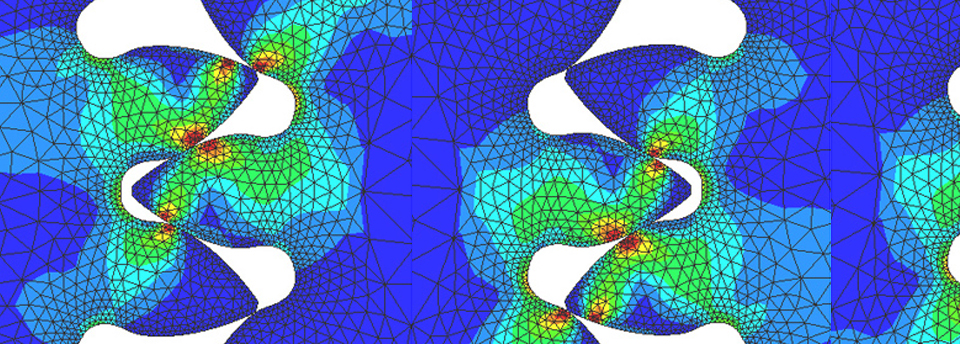
2D&3D
This program is the practical application of the finite element method to structural analysis were the 2D elasticity hypotheses are fulfill (plane stress or plane strain). Also the 3D elasticity assumptions are considered.
There are a plenty of structures where you can make use of 2D elasticity hypothesis:
Plane stress problems: Prismatic structure where one dimension (thickness) is much smaller than the other two, and loads are contained in its mean plane: deep beams, squares with loads in its plane, buttress dams , etc .
Plane strain problems: Prismatic structure where one dimension (length) is much greater than the other two, and loads are uniformly distributed along its entire length: Retaining Walls, gravity dams, piping internal pressure and various problems ground engineering (tunnels, stress analysis under pads, etc.,).
Moreover, some structures, by their nature, do not allow the use of simplified models, so it is considered as a three-dimensional solid and the 3D elasticity general theory is used. Practical examples of such situations include concrete dams or other complex structure.
Downloads
Gid Interface
Programs
Validations
Beams
BEAMS is programs collection that applies the finite element method to the classic problem of bending of beams. The application of the FEM to the beams problem is interesting due the academic representation of concepts than can be easily understand and are apply in more complex problems such as plates and sheets.
The beams bending problem is described according to the classical theory of Euler Bernoulli slender beams, which diminish the shear deformation effect and makes use of C1 class shape functions. Also the problem is defined with C0 shape functions which correspond to Timoshenko’s beams theory that includes the shear strain effect.
Downloads
Plates
The plate theory is based on dimensional simplifications of the 3D elasticity theory, similar to those used in the analysis of beams. In essence, the various plate theories differ, similarly to the beams case, in the assumptions of the rotation of the normal to the mid-plane. Thus the Kirchhoff’s classical theory (analogous to the beams theory of Euler Bernoulli) says that these rotations are zero and the mid-plane’s normal remain straight after the deformation. In addition, more advanced theories like Reissner-Mindlin do not require the normal orthogonally with the mid-plane after the deformed configurations therefor takes the shear effects into account.
PLATES is the program collection that implement the two classical plate theories using finite elements specifically designed to avoid the numerical problems associated with plates.
Downloads
Shells
Typologically sheets can be regarded as a plate case generalization. The non coplanarity conferred by the geometric approach of the shell by plates permits the existence of axial forces (membrane forces) which, together with the bending effects, contributes to provide the foil bearing capacity higher than plates. SHELLS is the set of programs that apply the finite element method to the flat sheets calculation based on the plates ‘s classical theories. Some structures that can be analyzed are: bridges, decks, tanks, ship hulls, aircraft fuselage, vehicle bodies, etc.
Downloads
Axi-Shells
Many of the shell structures with high structural interest have rotational symmetry. This is the case for water tanks, sludge digesters, cooling towers for power plants, nuclear power plants with cylindrical walls and domes, and a large number of non-civil engineering shell structures, such as missiles, pressure vessels, aircraft, etc..
The main advantage in the study of axisymmetric shells is the drastic reduction in the mesh size which increases the calculation efficiency. AXI-SHELLS uses truncated cones finite element for the structure discretization, following a similar philosophy to the analysis of curved shells with flat elements.
Downloads
GiD Interface
Programs
Validations
Heat
Poisson’s equation mathematically expresses the behavior of numerous physical problems such as the heat conduction mechanism through a body, or a liquid flow in a permeable medium. The implementation of this equation in a finite element program is a classic exercise with interesting and practical applications.
In MAT-FEM program series this equation have been studied in 1, 2 and 3D in a simple and understandable implementation.
Downloads
GiD Interface
Programs
Validations
Sound
Many problems related to steady-state oscillations (mechanical, acoustical, thermal and electromagnetic) lead to the two-dimensional Helmholtz equation (∇^2+k^2 )u=0
This equation is a time-independent linear partial differential equation. The interpretation of the unknown u and the parameter k depends on what the equation models. The most common areas are wave propagation problems and quantum mechanics, in which case u is the amplitude of a time-harmonic wave and the orbitals for an energy state, respectively. This equation is solved with the FEM in order to show the application of the method in other fields.
Downloads
GiD Interface
Programs
Validations
R+D
In this final section you will find the research work done by the students from the Escola Tècnica Superior d’Enginyers de Camins, Canals i Ports de Barcelona who have conducted his research using the MAT-fem resources under the directions of the school’s professors. In recognition of his work and thinking about the utility that others may have of it, we publish in this section the programs and public documents under the license CC BY-SA Creative Commons.
Downloads
Minor Thesis
- Development and application of a finite element model to calculate laminated composite, Albert Llanos Sánchez – Download – Minor Thesis
- Study of composite materials using zigzag theory on Timoshenko beams, Miguel Masó Sotomayor – Download – Minor Thesis
- A structural analysis procedure by the finite element method using adaptive mesh refinement and a preset error, Miquel Portabella Castany – Download – Minor Thesis
Contact Us
Would you like to find out more about how this software can help you in the practical analysis of structures and field problems?